
Native New York and Shelley Niro’s 500 Year Itch
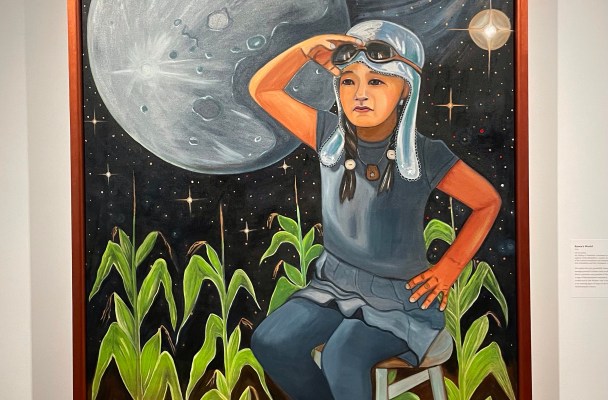
Shelley Niro ‘Raven’s World’
A day off in New York meant the chance to return to the Museum of the American Indian and two fascinating exhibitions: ‘Native New York’s’ half-millennial history of indigenous people on the east coast, and Mowhawk artist, Shelley Niro’s, extraordinary retrospective, ‘500 Year Itch’.
I had never before encountered Shelley Niro’s work but was mesmerised from the first self-portrait, ‘Travelling Through’, in which the artist stands stern in traditional Mohawk dress, knifed up in front of a canoe, amidst brightly coloured flowers, backed by a Van Gogh blue sky.
This turned out to be the first part of a triptych about the journey through life, and a hint to the role indigenous women played in furnishing European explorers with the knowledge that enabled them to survive voyages of exploration through the North American interior.
In ‘Continuing the Journey’ Niro is dressed in Mohawk leathers, a delicately sequined bag strung across a shoulder, and her canoe now suggesting a capacity for celestial voyage through the starlit sky. By ‘Wishing a River’ Niro is in modern western garb, bar mocassined feet, still with a canoe, and surveying a river than winds through fields of crops.
My favourite piece of all, ‘Raven’s World’, stars Niro’s grand-daughter confidently surveying the future in her aviator cap (an allusion to Sky Woman – the superhero mother of all Haudensaunee), sitting amidst robust looking crops and backed by a full moon symbolising grand-mothers and the hope that the Haudensaunee’s matriarchal culture will survive and thrive.
The belief that humans are part of nature, not conquerors of it, is a thread through Shelley Niro’s work, as it is in ‘Native New York’, an exhibition in an adjacent room that charts the history of indigenous people since European settlers arrived in north America.
I loved the language as much as anything: for some reason Europeans stuck an ‘n’ on the end of ‘Manhatta’ – meaning ‘place to gather wood’ when the island was still a forest;; ‘Shorakapkok’ is the ‘sitting down place’ in what is now Inwood; ‘Poospatuck’ – meaning ‘where the waters meet’ – was Long Island’s name when indigenous people were fashioning the most exquisitely beautiful ‘wampum’ bead-work from shells.
Those ‘wampum’ were used as more than mere decoration. Messages in such jewellery turned them into treaties – the museum displays one such that was used to record a deal with British settlers over land rights and another, by virtue of it’s all-purple colour, to signal the threat of war.
Among the beauty there is, of course, also great sadness, betrayal and brutality. Having fought for the nascent American state against the British in the War of Independence, the Mohawk tribe received words of friendship from George Washington but not the return of their lands. They were forced into exile, eventually settling in Wisconsin.
A thriving population of 20,000 indigenous Americans around modern day New York was reduced to barely 3,000 by a combination of guns, germs and European steel. A century later, Mohawk iron-workers helped construct the Empire State Building (‘Tiotenonhsate’ – the tall house) and many of the most iconic of Manhattan’s skyscrapers.
I stood for many minutes at a mesmerising interactive installation the shape of a small pond, rippling with simulated water which when activated by waving hand revealed the story of The Peacemaker, who brought the 5 (later 6) nations of the Haudensaunee together.
It was all a lot to take in and I was glad that the small museum cafe has now re-opened and is serving decent vegan food, providing a chance to sit and reflect before going back in for one more look at ‘Raven’s World’.
 markontour
Leave a comment