Despite the underwhelming outcomes from the COP29 climate talks in Baku, multilateralism remains the most critical tool we have for addressing climate breakdown. To reinvigorate it, lets shift COPs from negotiation to implementation using city leadership.
Everyone knows the panda from the multitude of iconic images that this loveable-looking bear has inspired around the world. But surely there is nowhere where the panda’s image can be more ubiquitous than in Chengdu, an enormous city of 21 million residents in south-western China and home to the Chengdu Research Base of Giant Panda Breeding, which I was privileged to visit this week.
In the winter months I look for lichen. That habit, which I started because my binoculars are made temporarily redundant by reduced bird numbers on the uplands of the Bannau Brycheiniog during January, has developed new purpose since reading Guy Shrubsole’s magnificent ‘The Lost Rainforests of Britain’. Now I understand that the abundant varieties of these plant/fungi collaborations across the Welsh hills are not just distraction from the absence of something more exciting, but something incredible and historic in their own right – evidence of the last remaining fragments of the temperatre rainfrorests which once covered these isles.
Part adventure travelogue, part popular science journalism, part conveyor of big truths, Ben Rawlence‘s The Treeline is a beautifully written, mind-opening account of how trees are migrating north in response to climate breakdown. It’s a page-turner and yet also book I lingered over, because there were so many passages that necessitated an intake of breath, followed by a solemn stare into the distance, and then a re-read to make sure I had fully understood the devastating implications of the new information just imbibed.
Yesterday I saw a Goldcrest, Europe’s smallest bird. There are 600,000 breeding pairs in Britain and they are reasonably commonplace in the coniferous woods which they make home, but it is the first time I have spotted one in the Brecon Beacons. More to the point, they are stunningly attired- “a tiny bird with a big hairdo” according to the Wildlife Trusts – and so make a big impression, first with a flash of green on the wing and then the bright yellow mohican on the head (orange in the male).
Oxfam’s annual wealth report, Inequality Kills, has rightly attracted attention for revealing how the incomes of the world’s ten richest people have doubled during the pandemic, while the incomes of 99% of people have effectively reduced during the same period. But the report, along with other recent analysis, also provides further critical evidence of how economic inequality is driving climate breakdown. As such, it is a problem that is not just confined to a handful of billionaires but the excessive consumption patterns of the wealthiest few hundred million of us, who compromise under 10 per cent of humanity but cause over half of its greenhouse gas pollution.
Cranes, large white wetland birds, standing 1.3 metres tall with flamboyant tail-feathers that bob about as they graze, were hunted to extinction in Britain four hundred years ago. But last weekend we went to visit a now thriving resident population at the Slimbridge Wetland Centre on the Severn Estuary near Bristol. It was a magical and uplifting experience, and it turned out that the Cranes shared the billing with an astonishing cast of other beautiful wildfowl.
Revisiting a half-finished blog from the end of 2021, I was reminded how angry I was hearing Shell’s CEO proclaim green credentials one minute, and in the next breath complain that being told to cut his company’s emissions in line with national targets was “unreasonable”. The job of the climate movement is to make it unacceptable to enrich yourself through destroying the eco-systems on which we all depend, and rally the majority of people behind political and economic approaches that instead enable human civilisation to survive and thrive.
As the dust settles on COP26 it is clearer than ever that the climate crisis is not going to be averted by inter-governmental negotiation. That’s not to ignore the momentum generated by COP26, or the incremental progress made in Glasgow. But the commitments on the table from national governments when the gavel came down fell well short of locking in action to halve global emissions this decade, and that was the ultimate indicator of success or failure. As a result there is an even more urgent need for cities and other non-state actors to lead immediate science-based climate action, and increase the impetus on national leaders.
The formation of the Climate Crisis Advisory Group, an independent group of scientists which published its first reports over the summer, may turn out to be a pivotal moment for humanity getting to grips with the climate emergency.
I approached The Ministry for the Future, eco sci-fi master, Kim Stanley Robinson’s latest book, with some trepidation. I was anticipating a grim imagining of a near future in which human civilisation descends into chaos as a result of failure to respond to the climate crisis, something I am generally trying to escape when I find time to pick up a novel. But while there is plenty that is frighteningly real in Robinson’s narrative – from millions dying in droughts, floods and fires, to the rise of global eco-terrorism as a generation realises that the one-percent really are willing to sacrifice their futures for short-term profit – ultimately ‘The Ministry of the Future’ is a manifesto of hope.
Analysis for C40’s Mayors’ COVID Recovery Taskforce shows this clearly – a big, fast global programme of green stimulus will create 50 million good new jobs in C40 cities alone, while also being the best route to protect health and enable us to get on track to halve greenhouse gas emissions by 2030, and make it to zero by 2050. So while we should rightly celebrate the moment when President Biden takes the USA back into the Paris Agreement, what is really going to matter in his first year in office is whether or not he is able to push through a green and just COVID recovery stimulus.
Despite the constant flood of bad news related to Covid-19, there are signs we are also witnessing unprecedented global dialogue, innovation and collaboration, offering hope that…
The COVID-19 crisis has again laid bare the current inability of nation states to work with each other to solve global problems in the face of President Trump’s continuing assaults on international institutions. In stark contrast, the world’s mayors leading cities worst affected by the COVID-19 crisis have been strengthening collaboration based on good science, robust data and common human interest, building off a decade of co-operation to tackle climate change.
“We disrupt eco-systems, and we shake viruses loose from their natural hosts. When that happens, they need a new host. Often, we are it.” So argues David Quammen in We Made the Coronavirus Epidemic, New York Times, 28 January. There have been a number of similar articles pointing out the link between human destruction of biodiversity and the prevalence of viruses that cross the barrier between wild animals and humans. I have found it useful to summarise them and so am sharing here in case it is helpful for others also.
Prior to the anthropocene, a daffodil’s message that it was ready to be pollinated might have drifted many miles, attracting thriving populations of bees and ladybirds from a wide neighbourhood. Today a flower’s range is likely to be restricted to a couple of hundred metres, as dirty air dampens their scent and mobile phone traffic messes up the subtle electronic signals that pollinators use to identify and map the right flowers to visit. This and so much more I learned at wonderful ‘Swarm: artists respond to the pollinator crisis’ exhibition at the little Vestry House Museum in Walthamstow this weekend.
A recent blog by my colleague, Luke Sherlock, comes highly recommended by markontour and is well worth a read for anyone still wondering if China is serious about building an ‘ecological civilisation’. Reviewing Barbara Finamore’s recent book, ‘Will China Save the Planet?’, Luke highlights that China’s federal government is quietly delivering something like the Green New Deal that a growing climate emergency movement is demanding in the USA and Europe (and is already being delivered in cities like Los Angeles and New York).
During a London Climate Week event at Chatham House* last week an audience member asked the panel of which I was a member “How are we going to make people pay for climate action?” Given that the questioner had introduced herself as representing the oil company, Shell, my flippant response was that I knew where to start – by taxing those who have done the most to cause a climate crisis, namely fossil fuel companies like Shell. In fact we should tax them out of business, because companies that continue to put short term profit before the continued existence of the human race don’t have a place in a climate-safe world.
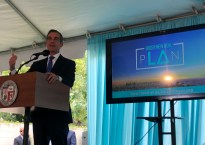
Los Angeles’ Green New Deal, which I was privileged to join Mayor Garcetti in launching this week, provides a template for a new era of climate leadership. being of Angelenos. It is a strategy to take forward the whole of society and thus moves climate change from a peripheral issue to the central organising principle of government.
Today and for the rest of the week normal business in London will be disrupted by Extinction Rebellion protestors trying to rouse their fellow citizens to face the climate emergency into which we have sleep-walked. Their tactics aren’t everyone’s cup of tea, but if shutting down a few streets is what it takes to draw attention to the fact that we are now in a battle against the clock to prevent the (still entirely avoidable) destruction of the eco-system that makes possible human life on Earth, then that seems like an entirely rational response to me.
Last Friday I was inspired and shamed in equal measure by attending the huge ‘School Strike for Climate’ in Oslo. “You’ll die of old age, but I’ll die of climate change” accused one placard. “System change, not climate change” read many more. Thousands of children thronged, chanting into the square outside Parliament to try and make their parents’ generation, of which I am a member in denial, wake up and stop destroying the eco-system that enables humanity to thrive on the only planet we have access to.
Today a rare treat – a guest blog from Ms Markontour, reviewing ‘A natural history of the hedgerow and ditches, dykes and dry stone walls’, by John Wright: When I think of hedgerows I think of nature, green leaves, fragrant May blossom and noisy, busy birds. John Wright puts the hedgerow in historical context starting with pre-history which turns out to be fascinating. Piecing together archaeological and ancient written records, he walks us through time from the last ice age 10,000 years ago.
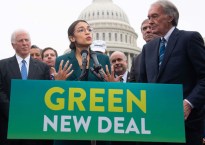
There has been so much said and written about the Green New Deal put before the United States’ Congress by the remarkable New York Representative, Alexandria Ocasia-Cortez, that I hesitate to add anything more. However, it really is worth noting how coherently the Green New Deal Resolution melds action to tackle climate change, with measures to counteract the obscene inequality and wage stagnation that has built up over decades of neo-liberal political supremacy in the USA (and my home country of Great Britain).
A superb report, ‘Food in the Anthropocene’, published last week by EAT and The Lancet sets out with tremendous clarity how “global food production constitutes the single largest driver of environmental degradation” in the world today. Moreover, it explains how “a diet rich in plant-based foods and with fewer animal sourced foods confers both improved health and environmental benefits”. It is a must-read for policy-makers everywhere, but if you don’t have time even to peruse the hard-hitting executive summary, these are the key points:
I had a litter picker for my birthday – the grabber thing that means you don’t have to bend down to pick things up. It’s not a sign of premature ageing (I’m still in my late youth, you know), but Ms Markontour had noted the rising frequency with which I come through the front door grumbling about all the mess in our street and decided to provide me with the means to do something about it. Today I tried it out for the first time and now Bakers Avenue is going to win Britain’s Cleanest Street!
The Leyton Marshes, part of the Lea Valley which flows down from the Chiltern Hills all the way through London to disgorge into the Thames near Poplar, is a rare haven for wildlife and tranquility in the great metropolis in which markontour lives. Indeed, the beauty of the Lea Valley’s parks, canal and marshes is the main reason we moved to Walthamstow fifteen years ago. Yet now it is threatened by a badly conceived development put forward by the very authority that was created to protect it. It has to be stopped.
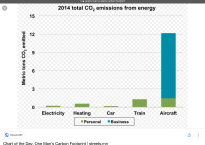
I am spending a whole day on trains today, as I seek to find a lower carbon route from London to Copenhagen. I visit that wonderful city regularly for work and am likely to need to do so more in the future. In a previous job I used to take the night train, but time pressures pushed me into flying – a bad habit that I am now trying to break. Well aware of the hypocrisy of a climate change professional spending so much time inside a kerosene-fuelled metal bird, I am very much hoping that the day-time rail route proves viable.
Radio Four’s new series, ‘Economics with Subtitles’, got off to a great start with a programme explaining why GDP growth is not a useful indicator of the success of a society. “Economics is the only discipline where endless growth is regarded as a good thing”, says presenter Steve Bugeja, quoting a character in a Jonathan Frantzen novel, ”In biology there’s a word for that – and it’s cancer.”
I can’t quite believe that I am writing a blog about the Hampton Court Flower Show. This is not markontour’s natural territory. But having failed on the promise to learn how to salsa that was the mainstay of my 40th birthday present to Ms markontour, I felt compelled to follow through with sharing an Xmas present of tickets to the aforementioned floral festival. I have to admit, I rather enjoyed it.
‘H is for Hawk’ won many “Best Non-Fiction” garlands last year and so there are no shortages of reviews, yet it is just so good that markontour would not be complete without adding to the eulogies. I have never had an interest in falconry, or any desire to train a wild animal of any kind, but ultimately ‘H is for Hawk’ simply made me want to be outside and enjoying our wonderful planet while it is still a place of extraordinary diversity and beauty.
A decade ago, Tim Flannery’s ‘The Weathermakers‘ was one of a handful of rapidly-read books that inspired me to understand the true enormity of the climate…
On Sunday I arrived in Rio de Janeiro just as powerful explosion was blowing to smithereens the elevated highway that channels slow-moving traffic north to south…
On Thursday night, as I half-slumbered through a red-eye journey home from four days of uplifting discussions about cities’ carbon reduction efforts, my tired brain took…
I had one of those wonderful big city moments yesterday, when you are passing through a routinely familiar area, barely logging the surroundings, only to be…
What a day Sunday was on Radio 6 (6Music if you must), but Jarvis Cocker stole the show with his two hour chat on music and nature with David Attenborough.
Tuesday saw the launch of the Global Ocean Commission, which I had the privilege to attend at the Commonwealth Club on London’s Embankment. Commission co-chair, and…
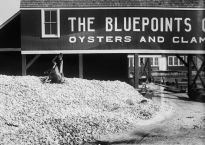
Alongside generous hand-outs from native Americans, the first European settlers to cross the Atlantic largely survived off the plentiful supplies of oysters that lined the coast…

























 markontour