Federico Garcia Lorca and the duende
Despite part-inspiring one of my favourite Clash songs, ‘Spanish Bombs’, until visiting Andulucia this summer I knew nothing about the legendary Spanish poet and playwright, Federica Garcia Lorca, other than the intriguing reference in Joe Strummer’s lyric: “Oh please leave the ventana open / Federico Garcia Lorca is dead and gone”. Today in the small tourist village of Pampaneira, a dense huddle of whitewashed stone houses cramped onto impossibly steep terraces on the southern edge of an escarpment of the Sierra Nevada, I was intrigued again by Lorca – this time generating enough impetus to read up a bit.
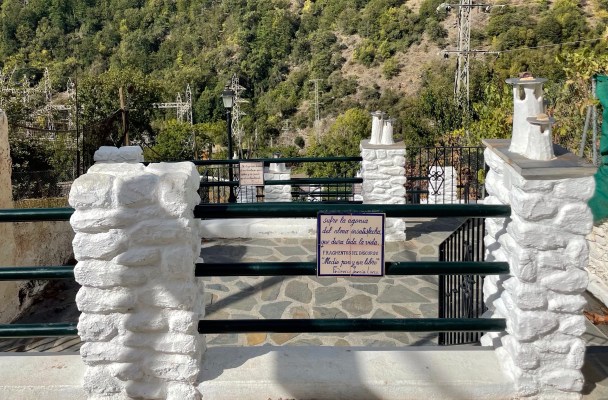
Today it was not a punk song, but a trail of porcelain plaques embedded into a series of steps leading down to Pampaneira’s hydro-electric plant that referenced Lorca, each beckoning with an elegant line of his prose or poetry. I am relying on Google Lens for the efficacy of the translation, but the theme was the sustenance provided by knowledge and literature. One read: “If I were hungry I would not ask for a loaf of bread, but for half a loaf and a book”.
A car journey listen to In Our Time introduced me to the basics about Lorca – born in 1898 to wealthy Spanish parents, a university friend of Dali who managed to bridge both surrealism (there’s a fair bit of Milk Wood-esque Dylan Thomas in the few of his poems that I have now speed-read) and folk tales. Infamous for putting strong female characters front and centre of his plays (there was violent uproar when one of his lead female characters killed her husband), persecuted for being gay in a society that forbade homosexuality, and this along with his generally progressive views and support for the Spanish republic was probably what brought his short life to a premature end in 1936 (his body is one of the thousands executed by the fascists and never found).
What really caught my attention in today’s crash course in Lorca, however, was his espousal of the concept of “duende”, which he described as: “a force, not a labour, a struggle, not a thought.. I heard an old maestro of the guitar say: ‘The duende is not in the throat: the duende surges up, inside, from the soles of the feet.’ Meaning that it is not a question of skill, but of a style that is truly alive: meaning, it is in the veins.” Lorca identified its presence, particularly, in cante jondo, a kind of Andalusian folk music. “Behind these poems,” he wrote, “lurks a terrible question that has no answer.”
Indie singer, Nick Cave, is also a fan of duende, which he described as “the eerie and inexplicable sadness that lives at the heart of certain works of art.” Riffing off Cave’s thoughts, Laura Barton, the British music journalist, explored the duende’s impact on rock music in a fantastic article in the Guardian 15 years ago.
Barton cites Nick Cave’s ‘People Ain’t No Good’ as an example of the genre, although at least half of Cave’s oevre would fit the category. Cave notes the same is true for many of the songs of Bob Dylan, Neil Young, Polly Harvey and Leonard Cohen. Barton adds Karen Dalton and Bonnie ‘Prince’ Billy. I would add most of Bruce Springsteen’s songs on Nebraska, or Darkness on the Edge of Town, along with Elbow’s ‘Sad Captains’, First Aid Kit’s ‘Wild Horses II’, or Nicolai Dunger’s ‘Last Night I Dreamt of Mississippi’.
But coming back to Spanish Bombs, was Joe Strummer channelling the forces of duende, beyond the more obvious references to the heroism of revolutionary struggle and the horrors of war and violent conflict?
There’s certainly little sense of duende in the punk beat and strum of the music itself, and the English lyrics mostly muse on the recent ETA bombings in Spain, a correlation with the IRA attacks in Britain, and a reflection back on the Spanish Civil War.
The bits of pidgin-Spanish (“Clash Spanish” as Joe Strummer would have it), however, do suggest at least a tilt towards duende. The song’s opening line reveals Strummer’s geographic focus at the time – “Spanish songs in Andalucia”, the southern province where I am currently holidaying and which birthed both Federico Garcia Lorca and Strummer’s ex-girldfriend, Palmolive (founder of punk band The Slits), with whom he had recently split at the time he wrote Spanish Bombs. While native Spanish speakers apparently would quibble, what Strummer says he intended to convey when he chorused “Yo t’quierro y finito, yo te querda, oh ma côrazon”, was “I love you and goodbye / I want you, but – oh my aching heart”. Very duende.
And then there’s the reference to to Lorca himself: “Oh please leave the ventana open / Federico Lorca is dead and gone”. “Ventana” means “window” in Spanish, and Strummer was echoing García Lorca’s achingly poignant line his poem “Farewell”: “If I die, leave the balcony open!”. Duende indeed.
– I’ve started a duende playlist, based on this blog, which will no doubt evolve.
 markontour
Leave a comment