
Barcelona
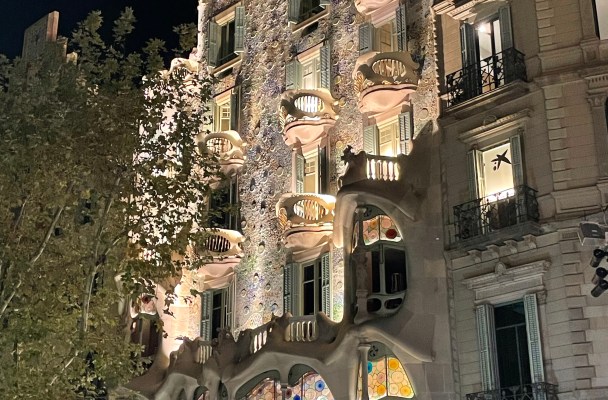
This is going to need some fleshing out on subsequent visits, but getting back to the original roots of markontour.com, here are fragmentary reflections on Barcleona, from three days working there and one day of leisure.
Museu d’Historia de Barcelona
Markontour makes it his business to visit the town museum in urban areas big and small. It’s not easy in the Catalan capital because the Barcelona History Museum is spread over six sites around the city. I visited only that in the old Gothic quarter of the city and loved it, not least because of it’s extraordinary Roman basement.
Like many cities, modern Barcelona was built, quite literally, on the foundations of an ancient Roman settlement – Barcino. Covering a mere 10 hectares (for comparison, ancient Rome spanned 1,400ha), this walled town must, nevertheless, have been impressive. The portion that was uncovered on the site of what is now the museum contains the remains of a laundry service, dyeing operation, fish preparation facilities, and a fairly extensive wine fermentation businesses, the globular pottery vats of which are still mostly intact.
Initially built as a fortress, the garrison became a colony as Emperor Augustus’ expansionary phase in Spain came to a close and centurions were encouraged to put down roots and Romanise the conquered land.
Exquisite glassware, jewellery, pottery, amphora, a stone games table replete with dice, and bazaars-worth of nose-chipped sculptures remind museum visitors of the breadth of Roman craft-personship and wealth of its citizens. The products on display here were owned by the Roman working and middle classes. The extensive drain system make equal testament to Roman engineering prowess.
It took 1,400 years for Europe to regain such productive heights, sadly again on the back of slavery-fuelled development. That long decline and slow recovery in material wealth is physically apparent as one descends into the Roman archaeological part of the Museu. A sort of sedimentation of construction is apparent as one descends from a rather beautiful renaissance building, enhanced with some twenty-first century tweaks, into the ruins of a medieval church constructed with stone from the Roman buildings it replaced, right through to the foundations. It is at first confusing and then instructive to see a great slab of Latin-inscribed stone lying on its side as part the ruins of a medieval wall, that itself props up the modern-day building.
The Gothic Quarter
Perhaps unsurprisingly, there are lots of gargoyles, some almost touching each other high above tourists’ heads in the narrow lanes. Great for a walkabout.
Espai Mescladis
Little restaurant run by refugees that sprawls out across the street, cleverly making use of every available niche of space and offering a menu that includes plenty of delicious plant-based dishes alongside meat and fish. I enjoyed a toasted craft beer with my romesco-sauced tofu plate.
Teresa Carles
Lovely indoor vegetarian restaurant, where I enjoyed a gorgeous cannelloni and a significant portion of mango ice-cream.
Bar Calders
Friendly no-nonsense tapas bar in the San Antoni district, where we enjoyed drinks with the C40 Barcelona team.


One Response to “Barcelona”
So interesting. Want to go to Barcelona. X
<
div>
Sent from my iPhone
<
div dir=”ltr”>
<
blockquote type=”cite”>
LikeLike