
Transcendence, Excalibur and how Britons forgot how to make steel
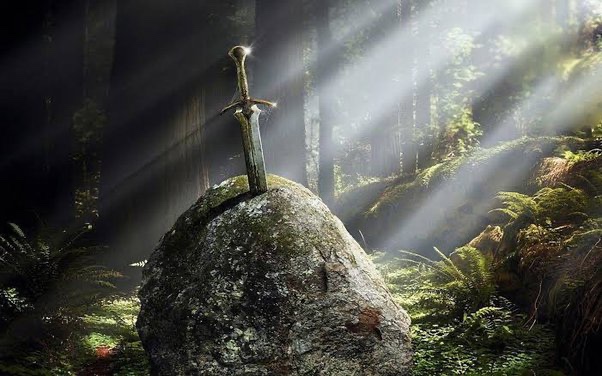
I like to have at least a couple of books on the go at all times and two of my current crop – Transcendence by Gaia Vince and Bernard Cornwell’s Enemy of God – have provoked an unlikely fusion of ideas: was King Arthur’s unbreakable sword, Excalibur, a mythic expression of the lost art of Roman steel-making? Did Merlin wield ‘magic’ by exploiting the human brain’s ability to convert mental anticipation into physical reality?
Transcendence is science writer, Gaia Vince’s, unputdownable exposition of how human evolution has been shaped by a constantly inter-twining combination of genes, environment and culture.
Enemy of God is the second part of Bernard Cornwell’s equally addictive re-telling of the legend of King Arthur, expertly persuading this reader that they are studying historical fiction, rather than indulging in fantasy, as he describes ancient Britons’ attempts to prevent Saxon colonisation.
What brings these two books together, in markontour’s holiday-enfeebled mind at least, is story-telling.
Vince’s thesis is that it is the interplay between genetics, environment and culture that has made homo sapiens what we are today. Each are equally important, but Transcendence puts the emphasis on culture, as it is the part of the formula that is most often over-looked by other scientists. “Just as biology has evolved strategies that improve the reproductive process for its genes”, she writes, “so culture has evolved adaptations to improve its reproduction”.
Our most important cultural trait, Vince explains, has been a propensity to collaborate. For the vast majority of homo sapiens’ 300,000 years we were never the biggest, strongest, or fastest species in any given habitat. Working together as a group rather than a collection of competing individuals, however, enabled our ancestors not only to survive but to become the planet’s dominant species.
Lots of other species collaborate, but humans’ particular reliance on co-operation encouraged the genetic development of speech, through which we devleoped language and so could share knowledge at a far greater level of detail than is possible than through the ‘show by doing’ method used by most other animals.
“A chimp can crack a nut by bashing it with a stone. Another chimp can learn this culture and it doesn’t matter what sort of stone is used and how he (sic) bashes it, eventually the nut will probably crack.” But “developing nut-cracking further to make it more efficient would involve selecting a particular type or shape of stone, or perhaps even shaping the stone. In other words, it would mean adding steps, each of which has to be accurately remembered, in the right order, and demonstrated to another chimp, who would then need to learn the steps and their order and also transmit them.” That requires language.
Over time, language enabled us to share complex, multi-step processes like fire-making and a suite of other survival mechanisms so collectively complex that it would have been “impossible for an individual to come up with them all in a single lifetime. Instead they were learning from each other, practising and remembering the details in such a way that their cultural knowledge had become cumulative.”
This is where we get to story-telling: early humans discovered that one of the best ways to communicate complex information was to “encode it in narrative”, that is to tell stories.
“Information told through stories” rather than repeating facts, argues Vince, “is far more memorable – 22 times more, according to one study – because multiple parts of the brain are activated for narratives. A list of facts only activates the language-processing areas of the brain. However, the same information conveyed through a story also activates the brain areas relevant to the narrative: if the story involves jumping or running, the motor cortex lights up; whereas if it mentions someone’s satin blouse, the sensory part of the brain is activated. Our brains react as though we were living the story and experiencing it firsthand.”
In repeating stories, of course, we can sometimes lose sight of what is the most important information. A fundamental truth might be dressed up myth, but maybe the reader/listener only focuses on the fiction, not the facts. And that’s not only true when someone else is telling us a tale – even our own brain, our consciousness, does not always tell it to us straight.
This is where we start to come to the legends of King Arthur. For one of the curious traits of the human brain is to send signals that encourage individuals or groups of people to believe in things for which there is no rational, empirical evidence, from gods and magic, to pain without injury.
The traditional tales of King Arthur and the Knights of the Roundtable are unequivocally myths, legends, stories. Arthur derives his power from pulling a magic sword out of a boulder. Merlin, his magician, can conjure up storms, or make people disappear. A green giant visits Camelot on New Year’s Eve and challenges a knight to a bout of mutual execution, volunteering his own neck first, after which he picks up his decapitated head and walks off with it under his arm.
Bernard Cornwell’s aim in Enemy of God is to parse some historical reality from the myth, without losing the drama and adventure of turbulent times. Cornwell’s narrative – told through the voice of Arthur’s most loyal knight, Derfel – thus retains the contemporary belief in gods and magic because it was an integral part of how people lived in the fifth century, but also gives the reader a route to a rational explanation.
Thus, when Merlin, his druidic protege Nimue, Derfel and a small band of warriors overcome impossible odds to sneak into an Irish warlord’s territory on Ynys Mon (Anglessey), steal a cauldron that is one of the thirteen ‘treasures of Britain’, and escape despite being surrounded and vastly outnumbered, everyone present believes it is because of Merlin’s magic.
Shaking his staff at the sky, Merlin summons a mist that allows the Britons to walk right through enemy lines and hide-out in an ancient burial mound, protected by a charm of concealment.
Observed through Derfel’s eyes the magic both is, and is not, real. The canny Merlin has been watching the weather and fog on Ynys Mon was as common then as now. The elaborate act of conjuring the mist, however, is enough to convince their Irish foes that there is dangerous magic afoot and they are too scared to move within it. Later, when the mist has cleared, Merlin’s burial mound hiding place is easy to spot but belief that such sacred places were guarded by ghouls prevents the pursuers from venturing in. The sanguine Merlin had no such fears, although he assures his own followers that this is only because his magic can overcome that of the ancients.
‘Magic’ in this context serves an evolutionary purpose: the Britons of the 5th century were struggling to preserve their culture. Having barely survived centuries of Roman colonisation, by the 5th century of the Arthurian legends they were struggling with a new conqueror – the marauding Saxons. Faced with a stronger enemy, Merlin and Nimue’s presumed power gives confidence to Arthur’s warriors to go into battles against the numerical odds.
Interestingly, Arthur himself is presented as religiously agnostic – a pragmatist in a period of great religious flux. His life’s purpose is to unite the Britons and expel the Saxons and so he is willing to join a Roman Mithraic cult because it inspires loyalty among his knights, happy to use Merlin’s quest to restore the Celtic gods if it rouses the masses, but also to fight alongside newly converted Christians as long as they share a common enemy in the Saxons (although he worries about the fanaticism of a sect that believe their god will return to Earth in 5 years time, when all non-believers will be condemned to eternal hell).
In Cornwell’s retelling, Merlin represents the Celtic druidic tradition: pagan sages who combined knowledge of the stars, seasons, and herbs with animalistic ceremonies, sacrifices, curses and magic. Merlin’s quest might be fantastical – to reassemble ancient treasures that will enable him to summon back old gods. But he and Nimue are also generally the wisest and most perceptive of Arthur’s advisers, for example, cleverly diverting the Saxons’ vicious (male) war dogs in a key battle by releasing a diversionary pack of bitches on heat.
Yet while Cornwell’s readers are discouraged from believing in the power of gods, Merlin’s ‘magic’ is real in the sense that he cleverly utilises what Vince describes as the placebo and the nocebo effects: tricks our brain play on us, or can be manipulated to play.
Placebos – ‘drugs’ that heal patients despite having no medicinal properties – work if the patient didn’t have a real physical ailment in the first place and believes the pill has cured them. The nocebo effect describes the reverse – for example how 60% of cancer patients who are about to start chemotherapy experience ‘anticipatory nausea’, essentially the ill-effects they have been told they are likely to feel when they actually start the treatment.
Both the placebo and nocebo effects are a product of biology – the fact that all pain is produced in the brain. We might ‘feel’ pain in our back but there are no pain receptors there or anywhere else, it is only our brain telling us to feel pain there so that we will act differently and protect an injured muscle or limb. Sometimes after experiencing a real physical injury which has subsequently healed our brain fails to turn off the warning lights and the pain continues. Up to eighty per cent of chronic pain is thought to be caused in this way, and thus can be turned off through techniques like somatic tracking when all medicinal or physiotherapy cures have failed.
Now that humanity is starting to understand a little of how our brains work that knowledge can be shared and passed down so that fewer people need suffer chronic pain, even if it doesn’t seem that we are making any progress as a species in reducing gullibility to those who spin stories designed to deceive and misinform.
Indeed, Vince stresses that the arc of knowledge transfer, copying and developing ideas and practices, is not always forward, using an example that again drew me back to Enemy of the God:
“When the Romans left Britain they carefully hid their iron nails and other metallurgy, protecting the knowledge that enabled them to make swords that wouldn’t snap, aqueducts and ships. A pit discovered in Scotland contained a seven-ton hoard of iron and steel nails buried by one such retreating Roman legion. The loss of the key technology of steel-making became mythologized in British legends of unbreakable weapons, such as Excalibur, the magical sword of King Arthur.” It would be 1,300 years before the secret of steel-making was rediscovered in Britain.
That sense of loss of (Roman) knowledge is a constant theme in Bernard Cornwell’s King Arthur trilogy. Arthur’s focus is to defeat the Saxon invaders and create a lasting peace based on a confederacy of pre-Roman British tribes. But he and his knights are only too happy to use Roman technology to do so, prizing Roman armour when they can find it, and marvelling at Roman architecture when they visit Londinium to parley with the Saxon chieftan, Cerdic. In a symbol of their loss of knowledge, however, as Arthur’s spearmen run, childlike, up the stairs of the first multi-storey buildings they have ever encountered, the floors of these Roman ruins begin to collapse beneath them.
Despite those European Dark Ages, preserving and building on knowledge through generations has, in general, been something homo sapiens do better than any other animal.
Vince posits that it is stories that have helped us do this. Australian aboriginal songlines, for example, are not just cultural performances but contain essential information for how to survive and thrive in challenging habitats. Knowing exactly what is good to eat, where it is safe to go etc is essential in the vast Australian outback and the songlines serve simultaneously as maps and encyclopaedias of how to do so.
The need to convey very specific information about place in Australian aboriginal communication has led to one fascinatingly unusual linguistic quirk – a cultural norm to always include directional positioning in a story. For example, even to tell the tale of new love, presumably Jandamarra would be “standing under the tallest tree in the centre of the Moyjil and facing North when Wylah, gliding towards him from the east, took his hand and told him she was going to teach him how to dance. He knew then he was about to fall in love.”
As someone who, pre-reliable smartphone map apps, always used to carry a compass, I loved gaining that new piece of knowledge. Similarly, as a story-reading addict I am delighted not only to have been reintroduced to some of the tales that first enraptured me as a small boy, but to be able to interpret them through the prism of science and history, and to have the means to share that knowledge with others.
One last thing I think I have learned from Transcendence: culture is important not just because it has been a key factor in our evolution over the past 300,000 years, but because how we live today will affect what we are tomorrow. Culture shapes our genetic development as well as the other way around. Let’s hope Phillip Larkin was right when he observed, with uncharacteristic positivity, “what will survive of us is love”.
 markontour
Leave a comment