
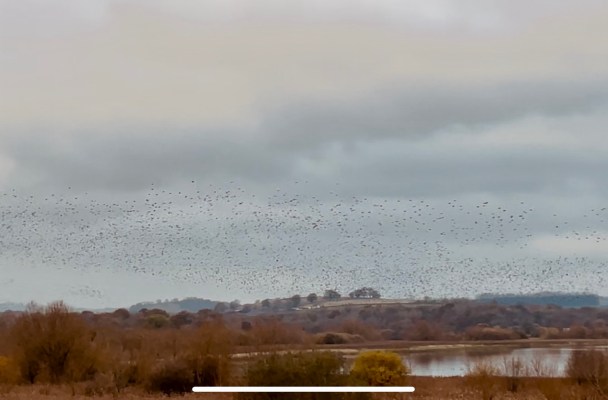
Murmuration over Llyn Syfaddan
Screenshot
It’s not been a great week for the future of human civilisation, but last weekend I stood mouth agape on the shore of Llyn Syfaddan (Llangorse Lake) gazing in wonder at one of nature’s greatest glories – a vast murmuration of birds. Flying in east to west over the space of an hour tens of thousands of starlings wheeled and reeled towards their winter home, pulsating like a single living organism stretching across an arms-length of sky and then, as one, dived to roost in the reed beds that line Lake Llangorse’s shore. It was simply breathtaking and to paraphrase Robert Smith in ‘A Forest’, which has been on repeat on Radio 6 Music this week (thank you), I want to see them do it again, and again, and again, and again.
While starling numbers have declined drastically in the last few decades, due to deadly pesticides that coat crops here and across British farms, boosted by winter visitors from continental Europe enough survive to gather in nightly numbers that can reach 100,000, according to one friendly birder I met in the lakeside bird hide.
Roosting together in such crowds can’t make for a peaceful night – the cacophony of bleeps, buzzes, twitters and clicks was extraordinary, not to mention the “whoosh” when sections periodically were spooked into taking back to the air – but the benefit is defence against predators. In a fight between a single hawk or owl and a lone starling there is no contest. But when confronted with a great swirling mass of birds, raptors have difficulty locking on to a single prey.
I have yet to read, however, of a convincing explanation for the dance of the murmuration itself and so I will hold on to the hope that it is simply an expression of joy and exuberance. It is certainly hypnotic – a “lava-lamp-like organic mass of pulsating black points” waxing and waning in the air, in avian-mad artist, Matt Sewell’s, description.
Scientists are confident about how such large flocks of birds appear to move as one, as Helen MacDonald explains in one of her essays in ‘Vesper Flights’: “the changing shape of starling flocks comes from each bird copying the motions of the six or seven others around it with extreme rapidity; their reaction time is less than a tenth of a second. Turns can propagate through a cloud of birds at speeds approaching ninety miles per hour, making murmurations look from a distance like a single pulsing, living organism.”
The dancing flight of these huge flocks of starlings is not the only remarkable thing about a murmuration – their sudden landing is also quite extraordinary to witness. Re-wilder and author, Isabella Tree, described almost exactly what markontour witnessed last weekend – the starlings “rolling and breaking like aerial waves until darkness siphons them down..like a genie disappearing into a bottle.” It really was like that – one minute a giant black cloud in the sky; the next they were all sucked down into the reeds.
While a murmuration is all about the collective “reacting to some common choreographic instructions” in David Attenborough’s words, each individual starling is also a bird of extraordinary beauty. Especially in winter, when their glossy purple and green coats are flecked with white spots, the starling’s breast looks like the Milky Way on perfectly clear winters’ night.
For their galactic apparel alone, starlings have long been my favourite bird, and yet my childhood memory is of my Mum – who can usually find something good in every living thing – shooing them away to give smaller birds a chance to feed. Revisiting my childhood bird books to find out why, the starling is variously described as “impudent”, “a bully of the bird table”, and “as familiar as weeds in a garden and often just as unwelcome.” Once so numerous that a single flock could ransack entire crop-fields or gardens, my Readers Digest bird-bible pilloried the starling as “the tearaway of the bird-world”.
Starlings’ reputation hasn’t always been this bad, I am reliably informed*. In the Welsh legend cycle, the Mabinogion, starlings are celebrated when Branwen, captive in Ireland, sends one home as a messenger to her brother, Bendigeidfran.
With starlings now so depleted in numbers it is hard to reconcile these cold-hearted assessments with the ethereally attired, alien-voiced, and balletically empowered little wonders I watched for a perfect hour an a half last weekend. Message to all starlings – you’re welcome to visit markontour’s garden any time
Listening and Reading
– Erland Cooper, Murmurations
– Michael Rosen and Matt Sewell, Word of Mouth, Radio 4
– Naturebang, Starlings and Social Networks, Radio 4
– Save Our Birds, Matt Sewell
*Thank you to poet and novelist, Chris Meredith, for alerting me to the Mabinogion connection, and for the wonderful talk he gave recently about the great Welsh poet, Henry Vaughan for the Brecknock Society.
 markontour
Leave a comment