
A little bit of bread and no cheese
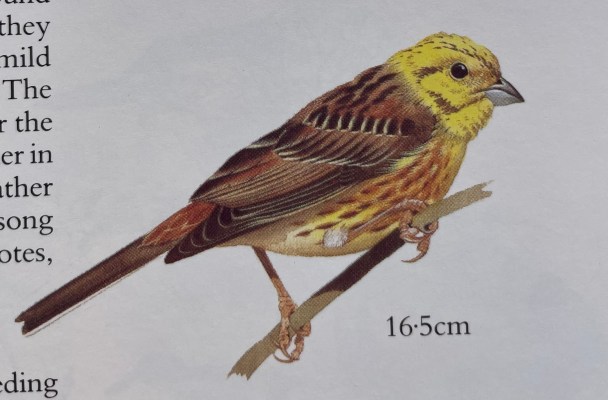
We know spring is imminent where I live in the Bannau Brycheiniog, not just from the growing warmth of the sun throughout the day, but because of the return of the familiar, high-pitched refrain of “a little bit of bread and no cheese’ whistling around the hills. It is, of course, the call of the Yellowhammer – Melyn yr Eithin in Welsh – and it’s a song to brighten any day.
Walking up to Cefn Moel before breakfast on Saturday morning the air was full of birdsong, but our meeting with the Yellowhammer was a good hour away.
This is the time of year when the heath, hedgerow and farmland birds start pairing up, claiming territory and building nests. Familiar calls mark the first stage of the climb from Cathedine Hill to Cefn Moel – a small flock of Sparrows chuntering in a bush, Great Tits and Blue Tits defending their patch, Wood Pigeons cooing overhead, and Blackbirds rustling away in the hedgerow.
There’s an invisible demarcation on this ancient right of way when you cross into the domain of a pair of Chaffinches. Yesterday morning a pari were positioned atop their hawthorn tree, the male flitting from branch to branch and proclaiming loudly as we passed, while their neighbours across the lane, the Wrens, sang improbably loudly for such a tiny bird reminding us their nesting claim deep inside the bushes.
It’s at this point in the climb that things start to get really noisy at this time of year, with a Songthrush adding its demented all-genre-fusion of pips, squeaks and trills into the mix, making no attempt at harmony and simply launching its soprano over the top of everyone else.
With the path now shifting from north to east, so that we faced directly into the rising sun, we started to pick out the Meadow Pipits and Skylarks practising their helicopter take-offs and aerial alarm calls from heathland that will soon be full of nests to protect.
Strangely, there weren’t any Stonechats yesterday morning, but most other days this week I have heard their onomatopoeic song, which sounds like two pebbles being gently rubbed together. Seconds later it is usually possible to spot a male Stonechat standing proud atop a wall or conveniently prominent bit of gorse, its buff chest barrelled out below a prominent white collar.
Soundless to grounded human ears, but suddenly visible in the sky above, a female Hen Harrier circled majestically, no doubt terrifying the thousands of voles in the shrub below – invisible to me, but an instant away from death if they stray into the keen sight of their nemesis above.
The biggest thrill of the morning, however, was yet to come and didn’t reveal itself until we’d paused to take in the sumptuous view of the Tretower valley below, and then started circled the Cefn Moel trig point before starting our descent to breakfast.
As usual we hear this little bunting before we see him (it was a male, which I point out only because so many bird books casually label all birds as “he” or “him”, as if the females don’t exist simply because it is often the male which sings most prominently). Indeed, often I only hear the Yellowhammer, because, as pre-eminent bird artist, Matt Sewell, describes, as a species they are “cute as a button made of butter but as nervous as a fireguard made of chocolate.”
The Yellowhammer’s instinct to hide from something as clumsy and rapacious as a human is sensible, but their stronger desire is to sing and so even if you can’t see them, once you recognise their song it is very obvious that Yellowhammers are around. And Yellowhammers make it pleasingly easy for the human ear to pick out their tune amidst the cacophony of a dawn chorus. As Simon Barnes explains in ‘Birdwatching With Your Eyes Closed’: “the Yellowhammer’s song has the most famous mnemonicot them all” – a repeated lilt of “a little bit of bread and no cheese”.
Or, at least, it sometimes does. More often, as Barnes half-complains, what we actually hear is something more like “bread-bread-bread-bread-bread-breadchee-eeese”. That was certainly closer to the refrain of our Yellowhammer yesterday. Perhaps he was hungry for a bit of dairy protein after a long, cold winter?
Whatever our Yellowhammer was actually singing about, by standing still for about ten minutes we were able to entice the bird to dance out of its hiding spot and snaffle some flies. Once in the open, while our ears continued to tune into to the Yellowhammer’s song, our eyes locked on to its yellow-gold mantle, bright as a buttercup in the dawn sunshine.
Over the next few weeks I hope to see a lot more of this Yellowhammer, during which time there will be a lot more fly-catching, along with a hefty turn at nest building, until in early May its partner will lay the first of two or more broods. I’ve never seen Yellowhammer eggs, but according to Raphael Nelson in ‘Birds of the hedgerow, field, and woodland’, “[t]he markings of purple-brown bear a strong resemblance to a pen and ink scrawl and have consequently given the bird a local name of the Scribbling Lark.”
Because Yellowhammers start to sing with the first bright weather of the year, they are a great bird to focus on if you’re trying to learn birds’ songs. And, once started, they basically don’t stop, and carry on singing right into the early summer when most other birds have given up. So if you want to practice birdwatching with your eyes closed, the Yellowhammer is a great place to start.
 markontour
Leave a comment