
Fast and Furious – the Gwalchglas
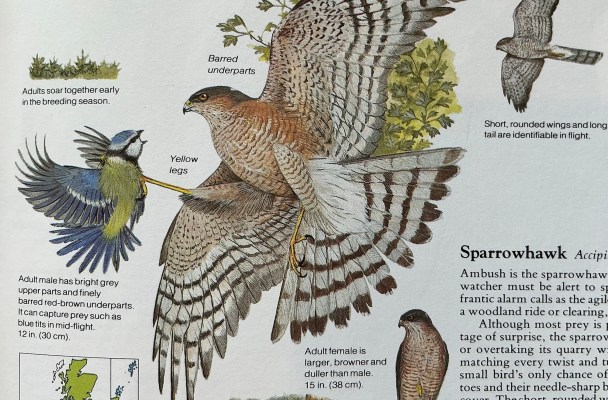
In his rousing book, Raptors, James Macdonald Lockhart describes the moment an unremarkable afternoon walk transforms into a never-to-be-forgotten moment: “Rising out of the bramble thicket beside a gate was a female Sparrowhawk. Wings spread, tail open in a fan as she rose..appearing as if from nowhere and then [she] was gone.” For Macdonald Lockhart, Sparrowhawks “operate in a different dimension to other birds of prey”. Having last week experienced an almost identical encounter with the lightning-fast aerial hunter that the Welsh call ‘Gwlchglas’, I know what he means.
Markontour’s Sparrowhawk encounter came as I was walking up the lane at the back of our house, getting ready for a run in the beautiful Bannau Brycheiniog National Park, as I do around 7am most mornings that I am in Wales. Suddenly, a raptor burst from the hedge about ten feet in front of me, with what looked like a Blackbird clutched in its talons, and flew up the hill in front of me.
So quick and unexpected was the event that I might have been less certain about what I had seen were it not for the fact that rather than getting as far away from me as possible, the raptor seemed a weighed down by its prey and so rested itself down barely twenty feet up the path – starting back at me warily. Moreover, over the next five days I saw the same Sparrowhawk twice again, including (incredibly, given all I have now read about the elusive nature of this raptor) a second time with prey in its talons. Queue a week of reading, listening and watching everything I could about this majestic hunter.
My first task was to be certain that what I had seen was a Sparrowhawk. Working by elimination, I was confident it was not one of the usual cohort of local raptors – Red Kite, Buzzard, and Hen Harrier – all of whom are substantially bigger than the relatively diminutive hawk that rush out in front of me. But the bigger clue was that as my startled hawk took off I was gifted a gorgeous view of her/his light brown and white barred, fanned-out tail, which a quick check on a birdwatching app confirmed was definitively that of a Sparrowhawk.
Next there was the location – breaching from a hedge that divides a large field from the rough lane that takes me up to my regular run upon Mynyyd Llangors. As Raphael Nelson describes in Birds of the Hedgerow, Field and Woodland, the Sparrowhawk’s “hunting method is to skim low towards a field in which birds are feeding, and suddenly to appear from behind a rick or through a gate.”
What would normally happen next would be for the hawk to take its prey to a convenient post and pluck it. I looked and looked for this spot on following days but couldn’t find the tell-tale signs of a circle of feathers. Perhaps, however, this Sparrowhawk felt safer to devour its meal under the cover of the hedge, keeping out of sight of potential adversaries like Buzzards and Red Kite that regularly circle overhead? Sparrowhawks, as one of the smaller raptors, have their predators too.
Determining gender was harder. I thought at first that what I saw must have been a male, because the bird was not that big for a hawk and like most raptors the male Sparrowhawk is smaller than the female.
That significant difference in size, however, influences where and what the male and females hunt. The males “short, rounded wings tell you it is a woodland hunter”, according to my ever-reliable Readers Digest Bird Guide (bought for me by my Grandma when I was 10 years old and still going strong), because their streamlined shape allows them to dart between the tress and bushes and keep up with the feints and jinks of their smaller prey.
Being fast enables male Sparrowhawks too feed off mostly small, quick song-birds and their juveniles, particularly Larks. When the female is incubating their eggs in the breeding season, the male becomes the sole food provider, hunting mostly small birds that nest in woods and hedgerows. But on a good day he might manage to take down something as big as a Blackbird, and so it was possible that my startled hunter was a male.
The topography where I spotted the hawk suggested differently, however. Female Sparrowhawks have sacrificed some agility in return for greater bulk, which they utilise when fighting off other female suitors of their chosen male. As a result, they are less proficient in dense woodland and prefer to hunt in open ground nearby, where they use the hedgerows as cover before surprising their prey. That is pretty much spot-on for where I saw my Sparrowhawk.
More likely a female, then? But female Sparrowhawks can be twice the size of a male and are supposed to be able to easily snatch a Blackbird and predate bird as big as a Wood Pigeon. Yet, after the split-second in which we were both frozen in shock by the sight of each other, my hawk seemed to be struggling to fly with a Blackbird in its talons, and after an energetic first burst, dropped down again only twenty or thirty feet in front of me.
After a pause, I crept cautiously forward, with the Sparrowhawk watching me as carefully as I observed her/him, and when I got too close, repeating the same ineffectual evasive action a further three times (much like the Heron’s we regularly disturb on the Monmouth and Brecon canal), before finally dropping the blackbird and shooting up to a tree branch to glower at me.
So maybe what I saw was a novice – a relatively young female, perhaps in its first winter as an adult. That tallies with the general appearance of the bird I observed – its feathers were definitively brown and white, while an older Sparrowhawk’s back feathers take on a bluey-grey sheen, something like that of the even smaller Merlin.
Inexperience might also explain why, astoundingly, when I returned from my run half an hour later, out of breath and dangerously close to being late for my first meeting of the day, as usual, the hawk was back where I first spotted it, plucking at its meal!
It was four days before I could go back up the lane again, after a forced absence due to meetings in London, and only my in-built life-optimism gave me any hope that I would see the Sparrowhawk again. The many books I had consulted in the intervening days all agreed that the Sparrowhawk is elusive and not the sort of bird you can usually plan to see.
Yet a few minutes into my warm-up walk, having enjoyed a cold half minute of listening to a Songthrush singing to the morning, I was again startled by a Sparrowhawk shooting out of the undergrowth, coming from nearly the same spot as before and, again, with a Blackbird trapped in its talons.
The same dance ensued, the hawk flying a little up the hill and then pausing as if to revive its’ energy, and each time I followed the bird flew on a few tens of feet further. There did appear to have been some learning from experience, however, as this time the Sparrowhawk dropped its prey a little earlier, apparently more confident that I was not going to steal it.
Now I really couldn’t believe my luck. Previously, markontour’s most significant Sparrowhawk sighting was of a concussed male who had barrelled into our backdoor. Oblivious to danger when hunting, it seems that many Sparrowhawks get terminally injured crashing into bushes or windows when their prey skilfully execute a ninety-degree turn millimetres before colliding with a hard surface. Fortunately, a neighbour of ours knew what to do with our dazed hunter and sped him off to a nearby Owl sanctuary, where they nursed him back to good health.
Other than that, there had been occasional fleeting glimpses of a small-ish hawk executing a lightning fast swoop to pluck an unsuspecting Sparrow or Blue Tit from our bird feeder, but otherwise in seven years of enjoying the Welsh countryside I hadn’t realised that Sparrowhawks were living alongside.
Then two Sparrowhawk sightings in a week – both with kills in its talons – birding doesn’t get any better!
And then, a couple of days later, taking advantage of a rare gap in the weekend rain, I decided to just to see if I really had discovered a favourite Sparrowhawk hunting spot and wandered up the lane again before breakfast.
At first there was disappointment – no Sparrowhawk in the hedge and, where I was expecting to see a circle of post-feast feathers, there was precious little evidence that the bird had ever been there, beyond some bright white bird poo, which is apparently characteristic of the Sparrowhawk. Turning on my heels, I consoled myself with the good fortune I had already enjoyed and started to head for home, but out of the corner of my eye I detected movement and there, perching conspicuously on one of the Birch trees that line the fields near us, was my Sparrowhawk. Back for more.
From everything I have read, listened to and watched in the last week, this latter behaviour is distinctly atypical for a bird that relies on stealth for a successful hunt. Sparrowhawks are supposed to hide and pounce, not flaunt and preen, but maybe my bird had already enjoyed its first meal of the day and was taking advantage of some rare sun-rays to dry out damp feathers?
This and many other loose ends need to be tied up, but suffice to say markontour is now a fully signed-up member of the Sparrowhawk fan club. I realise I am probably never again going to be so lucky as to repeat last week’s sightings and I write this from a snowbound New York. But when I get back to Wales I am going to keep my eyes on the sky rather than the hedgerows, because as Winter edges into Spring, and the avian breeding season commences, so the Sparrowhawk circus comes to town, promising aerial display of agility and acrobatics from the males, and duels between rival females..
 markontour
Leave a comment