
It’s all about Siff-Siaff
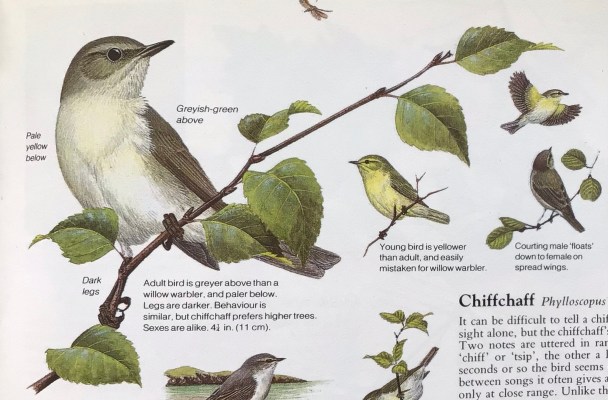
It’s all about Chiffchaff (Siff-Siaff in Welsh) in my little corner of the Bannau Brycheiniog (Brecon Beacons national park) at the moment. Their noisy onomatopoeiac call dominates the hedgerow airwaves, relegating the Robins and Blackbirds that have kept singing all winter to the sidelines. This is as it should be, Siff-Siaffs are one of the first migrants to arrive back in Britain and start singing and are, thus, a reliable indicator that spring is really here.
As Simon Barnes advises in ‘Birdwatching With Your Eyes Closed’, for those wishing to train their ears to pick out the songs of individual species of birds, these early weeks of spring are a great time. There are not yet that many birds singing and some of them, most notably the Chiffchaff, really stand out.
With Chiffchaff that’s just as well because they can be tough to spot visually and even when you do get a sighting they are virtually indistinguishable from their Warbler bretheren, Willow and Wood. Indeed, it wasn’t until the late eighteenth century that it was realised that there were three distinct species of what were then all called Willow Wren. It took the keen observational powers of the Reverend Gilbert White to tell the difference, and match together the Chiffchaff’s distinctive and much repeated call with its darker legs and a slightly less green breast, compared with the other Warblers.
Once you know it the Chiffchaff’s call is both distinctive and far carrying. I can hear one now outside my window. As David Attenborough notes in his ‘Life of Birds’: “It’s call is one of the few that is simple enough to be conveyed by written words”. “Chiff-chaff” or “Siff-Siaff” is what the Chiffchaff calls all day long.
To describe the song in more detail I will defer to the birdwatching bible my Grandma bought me in 1984 – anticipating by a good 30 years that I would become a birdwatcher. “Two notes are uttered in random order: one a high-pitched “chiff” or “tsip”, the other a lower “chaff” or “tsap”. After 75 seconds or so the bird seems to fall silent, but in the intervals between songs it often gives a soft, chirring call that is audible only at close range. Unlike the Willow Warbler, it likes to sing from high in a tree.”
Up top is where my local Chiffchaff likes to perch – on the uppermost branches of the two surviving Elms on our lane. But what are they doing up there, other than singing? Chiffchaff are certainly very busy little birds and “appears nervous, flittling rapidly through the treetops and constantly flicking its tail”, according to Kevin Walker in ‘Nature of the Brecon Beacons’, and like most birds, a large part of their waking time is spent looking for spiders and insects.
The bird’s scientific name suggests a more reflective nature than mine and Kevin Walker’s observations would suggest. The “Phylloscopus” in “Phylloscopus Collybita” means “examiner of leaves”. The second part seems even more incongruous – “collybita” means “money-changer” in Ancient Greek. But could this be a nod to the Chiffchaff’s call, as Dominic Couzens speculates in ‘A Bird a Day’, with the sound of coins being added to piles evoking the Chiffchaff’s call?
Maybe, but in any case it’s lovely to know that our Chiffchaff in the Bannau Brycheiniog have returned from their long mediterranean holidays in such good voice!


Leave a comment