
Fighters for Freedom
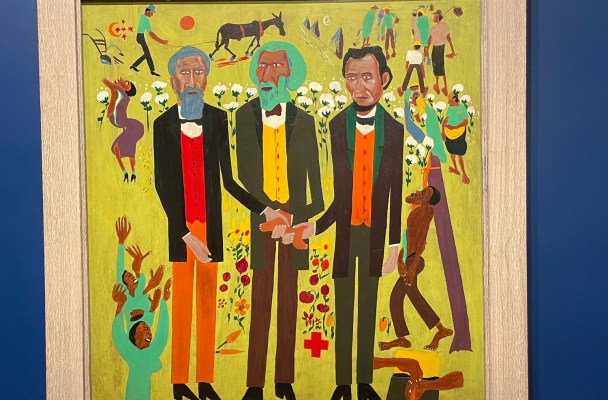
Robert H. Johnson’s ‘Three Great Abolitionists’ unites Abraham Lincoln, John Brown and Frederick Douglas in a hand-clasp that eluded these three leaders of the abolition of US slavery in their lifetimes. It is an arresting start to a rousing exhibition at the Smithsonian American Art Museum in Washington D.C. – all vibrant colours and stylised imagery in celebration of freedom fighters, liberationists, emancipators, socialists, mostly American people of colour.
I only had a spare hour to enjoy the exhibition, but what a privilege it was. The paintings in this retrospective represent Johnson’s portraiture, mostly created after he returned from Europe to the USA at the outbreak of the the Second World War. They were his last works before his wife’s premature death tipped him into a spiral of mental ill-health from which he never recovered.
Harriet Tubman, who escaped slavery on the Underground Railroad, served as a scout for the Union army in the Civil War, and was variously an abolitionist, suffragist, and agent of the Underground Railroad herself, is portrayed both as a young woman standing armed with a large rifle at the start of a long road to freedom, and older but still posessed of steely resolve.
The great baritone and actor, Paul Robeson, appears in the costumes of his most famous roles and travelling the world to preach freedom, anti-racism and socialism. His unmistakable voice also draws visitors into a small cinema showing clips of performances including his most famous – ‘Ol’ Man River’.
Johnson painted Touissant L’Overture, who led the slave rebellions that ultimately achieved the world’s first Black republic in Haiti (also the first country in the Caribbean to end slavery), in noble pose as a general and emancipator.
Marian Andersen, banned from performing in Washington concert halls because of the colour of her skin and so instead invited to sing at the feet of the Lincoln Memorial by Eleanor Roosevelt, looks in proud full voice in Johnson’s portrait. Her extraordinary singing is also on loop in the exhibition cinema, although her freedom song to the tune of the (highly imperialist) British national anthem had me confused for a minute!
Elsewhere, Stalin, Churchill and FDR are recorded dividing up the post-war world; Crispus Attucks lies bleeding in front of a British army firing line; Booker T. Washington is shown teaching at the agricultural college he founded to provide vocational education for African Americans; Nehru and Gandhi stand as modernist and traditionalist on the cusp of a new era for a post-colonial India.
One hour was not nearly enough, and yet I left feeling both educated and inspired.
 markontour
Leave a comment