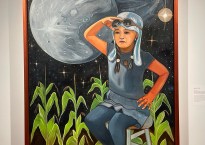
Sami artist, Britta Marakatt-Labba, campaigns for environmental protection and indigenous rights in Norway through the medium of embroidered landscapes and maps of epic beauty and subtle detail. The two hours I spent viewing a large retrospective of her work – ‘Moving the Needle’ – at the Nasjonal Museet in Oslo last weekend counts as my most enjoyable 2 hours wait for a hotel check-in. Sometimes delay really does generate pleasure.
Despite part-inspiring one of my favourite Clash songs, ‘Spanish Bombs’, until visiting Andulucia this summer I knew nothing about the legendary Spanish poet and playwright, Federica Garcia Lorca, other than the intriguing reference in Joe Strummer’s lyric: “Oh please leave the ventana open / Federico Garcia Lorca is dead and gone”. Today in the small tourist village of Pampaneira, a dense huddle of whitewashed stone houses cramped onto impossibly steep terraces on the southern edge of an escarpment of the Sierra Nevada, I was intrigued again by Lorca – this time generating enough impetus to read up a bit.
A day off in New York meant the chance to return to the Museum of the American Indian and two fascinating exhibitions: ‘Native New York’s’ half-millennial history of indigenous people on the east coast, and Mowhawk artist, Shelley Niro’s, extraordinary retrospective, ‘500 Year Itch’.
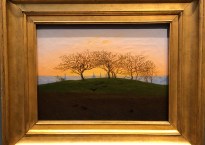
I have become a regular visitor to Hamburg this year, as it is a convenient stopping off point on the train journey from London through to Copenhagen, Stockholm and Oslo, where work takes me frequently. Usually I arrive late and leave early, but recently I discovered what I had been missing, after an early doors trip to the Hamburger Kuntshalle gallery. Most exciting were the landscapes of Caspar Friederich, an artist I had never previously encountered, but whose ‘Hill and Ploughed Field Near Dresden’ now lights up my soul every time I turn on my iPad.
Prior to the anthropocene, a daffodil’s message that it was ready to be pollinated might have drifted many miles, attracting thriving populations of bees and ladybirds from a wide neighbourhood. Today a flower’s range is likely to be restricted to a couple of hundred metres, as dirty air dampens their scent and mobile phone traffic messes up the subtle electronic signals that pollinators use to identify and map the right flowers to visit. This and so much more I learned at wonderful ‘Swarm: artists respond to the pollinator crisis’ exhibition at the little Vestry House Museum in Walthamstow this weekend.
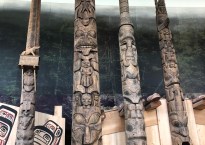
I was in Ottawa for just under 24 hours, but it made a great impression, particularly the Canadian Museum of History. The quality of First Nation artwork on display is extraordinary, utilising vibrant colour and strongly tied to nature infused with human imagination. Thus, adorning totem poles are variously Thunderbirds, Lightning Snakes, and even Supernatural Codfish. And while the totems were statements of power and, thus, perhaps it is not surprising that they were made ornate, echoing the philosophy of British nineteenth century designer, William Morris, practical function appears not to have been an obstacle to imbuing even the most commonplace objects with beauty. The head-baskets used daily to carry crops are designed with grace, and clubs used to stun seals and fish are shaped and decorated in homage to the fellow animals they are designed to kill. A jet-black, jewel encrusted bowl on display is one of the most beautiful objects I have ever seen.
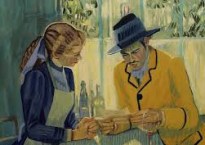
‘Loving Vincent’ is stunning animated oil painting, with every scene lovingly reproduced in the style of its subject and featuring many of the characters from Van Gogh’s greatest works. It is like the artist had painted his own life story, except had this been an autobiography one suspects that the subject would not have been treated so sympathetically. For Vincent, we learn, inspired much love, but never quite enough to overcome his own lack of self-worth.
It was probably the post-wedding hangover, but while I struggled with the room of abstracts, everything else about the Oxford Ashmolean gallery’s ‘American Modernism’ exhibition was pure joy.
Peter Von Tiesenhausen is an ecologically-minded artist, who salvages to create. His extraordinary ‘Relief’ – a mountain-scape sculpted from the clapperboards of an abandoned community hall – conveys beauty and sadness in equal quantities and is going to stay in my mind for a long time. As will the Art Gallery of Alberta’s retrospective exhibition ‘Undaunted: Canadian Women Painters of the 19th Century”. Who knew there was such a great gallery in Edmonton!
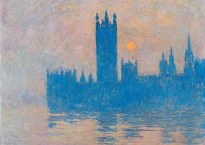
Tate Britain’s latest exhibition, ‘Impressionists in London – French artists in exile 1870-1904’, would be as much at home in a museum as in a gallery. My companion wanted more information about the brush-strokes, but markontour was happy to explore the social history of late nineteenth century London through the medium of some wonderful paintings inspired by fog. I wonder if a modern-day Monet is painting Delhi, Beijing, or even diesel-blackened London?






 markontour