Despite the underwhelming outcomes from the COP29 climate talks in Baku, multilateralism remains the most critical tool we have for addressing climate breakdown. To reinvigorate it, lets shift COPs from negotiation to implementation using city leadership.
Everyone knows the panda from the multitude of iconic images that this loveable-looking bear has inspired around the world. But surely there is nowhere where the panda’s image can be more ubiquitous than in Chengdu, an enormous city of 21 million residents in south-western China and home to the Chengdu Research Base of Giant Panda Breeding, which I was privileged to visit this week.
In the winter months I look for lichen. That habit, which I started because my binoculars are made temporarily redundant by reduced bird numbers on the uplands of the Bannau Brycheiniog during January, has developed new purpose since reading Guy Shrubsole’s magnificent ‘The Lost Rainforests of Britain’. Now I understand that the abundant varieties of these plant/fungi collaborations across the Welsh hills are not just distraction from the absence of something more exciting, but something incredible and historic in their own right – evidence of the last remaining fragments of the temperatre rainfrorests which once covered these isles.
Part adventure travelogue, part popular science journalism, part conveyor of big truths, Ben Rawlence‘s The Treeline is a beautifully written, mind-opening account of how trees are migrating north in response to climate breakdown. It’s a page-turner and yet also book I lingered over, because there were so many passages that necessitated an intake of breath, followed by a solemn stare into the distance, and then a re-read to make sure I had fully understood the devastating implications of the new information just imbibed.
Yesterday I saw a Goldcrest, Europe’s smallest bird. There are 600,000 breeding pairs in Britain and they are reasonably commonplace in the coniferous woods which they make home, but it is the first time I have spotted one in the Brecon Beacons. More to the point, they are stunningly attired- “a tiny bird with a big hairdo” according to the Wildlife Trusts – and so make a big impression, first with a flash of green on the wing and then the bright yellow mohican on the head (orange in the male).
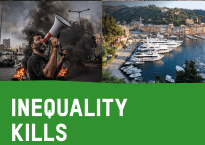
Oxfam’s annual wealth report, Inequality Kills, has rightly attracted attention for revealing how the incomes of the world’s ten richest people have doubled during the pandemic, while the incomes of 99% of people have effectively reduced during the same period. But the report, along with other recent analysis, also provides further critical evidence of how economic inequality is driving climate breakdown. As such, it is a problem that is not just confined to a handful of billionaires but the excessive consumption patterns of the wealthiest few hundred million of us, who compromise under 10 per cent of humanity but cause over half of its greenhouse gas pollution.
Cranes, large white wetland birds, standing 1.3 metres tall with flamboyant tail-feathers that bob about as they graze, were hunted to extinction in Britain four hundred years ago. But last weekend we went to visit a now thriving resident population at the Slimbridge Wetland Centre on the Severn Estuary near Bristol. It was a magical and uplifting experience, and it turned out that the Cranes shared the billing with an astonishing cast of other beautiful wildfowl.
Revisiting a half-finished blog from the end of 2021, I was reminded how angry I was hearing Shell’s CEO proclaim green credentials one minute, and in the next breath complain that being told to cut his company’s emissions in line with national targets was “unreasonable”. The job of the climate movement is to make it unacceptable to enrich yourself through destroying the eco-systems on which we all depend, and rally the majority of people behind political and economic approaches that instead enable human civilisation to survive and thrive.
As the dust settles on COP26 it is clearer than ever that the climate crisis is not going to be averted by inter-governmental negotiation. That’s not to ignore the momentum generated by COP26, or the incremental progress made in Glasgow. But the commitments on the table from national governments when the gavel came down fell well short of locking in action to halve global emissions this decade, and that was the ultimate indicator of success or failure. As a result there is an even more urgent need for cities and other non-state actors to lead immediate science-based climate action, and increase the impetus on national leaders.
The formation of the Climate Crisis Advisory Group, an independent group of scientists which published its first reports over the summer, may turn out to be a pivotal moment for humanity getting to grips with the climate emergency.







 markontour