Departure lounge ramblings on music, places, climate change and stuff outdoors

Posts from the ‘Places’ category

Cities and the interesting places within them

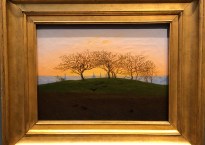
Colours of the hills and fields in Hamburg

I have become a regular visitor to Hamburg this year, as it is a convenient stopping off point on the train journey from London through to Copenhagen, Stockholm and Oslo, where work takes me frequently. Usually I arrive late and leave early, but recently I discovered what I had been missing, after an early doors trip to the Hamburger Kuntshalle gallery. Most exciting were the landscapes of Caspar Friederich, an artist I had never previously encountered, but whose ‘Hill and Ploughed Field Near Dresden’ now lights up my soul every time I turn on my iPad.


Smoke and mirrors

I was briefly into performing magic as a kid, inspired by Paul Daniels on the telly if truth be told. A visit to the Wellcome Collection’s fascinating new exhibition, ‘Smoke and Mirrors – The Psychology of Magic’, has re-ignited my interest and reminded me just how malleable the human mind can be.

The Boy Who Harnessed The Wind

“Overcoming poverty is not an act of charity, it is an act of justice”, said Nelson Mandela, in a quote that closes ‘Mandela: The Official Exhibition” on London’s southbank. He went on to explain how poverty can be overcome: “Like slavery and apartheid, poverty is not natural, it is man-made and it can be eradicated by the actions of human beings”.

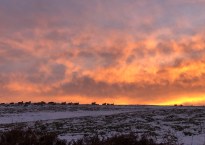
Sunshine on Mynydd Llangorse

Yesterday morning I was out with the dawn in order to catch the sun rising over the snow covered hills that surround our new Welsh home. At the peak of Mynnd Langorse a couple of hours later I met a man called Steve, who had fulfilled a thirty-year ambition to move here after first becoming enchanted with these Welsh hills after spending time in the valleys in 1984 as part of Lesbian and Gays Support the Miners (an uplifting experience that was so brilliantly portrayed in the film ‘Pride’).

Today I awoke to a frost hollow

Earlier this week I awoke to see a field of lost clouds, a huge bank of them, gently swirling in the valley beyond our front window, separated from their brethren who were floating in their rightful places in the sky above the Welsh hills.

The Devil’s Arse

Just above the Peak District village of Castleton there lurks a very large cave. So large, in fact, that it would take several days of crawling in the dark if one were foolhardy enough to try and traverse its entire thirteen mile extent. Those, like markontour, who regard such exploits as very much for other people to enjoy, can nevertheless experience some of the beauty of the caves from the relative safety of an entrance known as The Devil’s Arse.

Save Lea Marshes

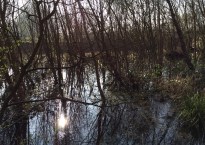
The Leyton Marshes, part of the Lea Valley which flows down from the Chiltern Hills all the way through London to disgorge into the Thames near Poplar, is a rare haven for wildlife and tranquility in the great metropolis in which markontour lives. Indeed, the beauty of the Lea Valley’s parks, canal and marshes is the main reason we moved to Walthamstow fifteen years ago. Yet now it is threatened by a badly conceived development put forward by the very authority that was created to protect it. It has to be stopped.

Size and the Big Apple

I love New York and visit regularly, but there are many things I still don’t understand about the Big Apple/Big Oyster, and size is one of them. Yesterday I was wedged in so tight between two ample sized pairs of buttocks on either side of me on the subway that I almost missed my stop, so difficult was it to extract myself. In the end one of my fellow passengers had to give me a push.

Ottawa’s Grand Hall

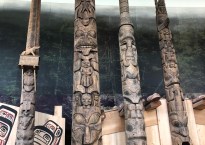
I was in Ottawa for just under 24 hours, but it made a great impression, particularly the Canadian Museum of History. The quality of First Nation artwork on display is extraordinary, utilising vibrant colour and strongly tied to nature infused with human imagination. Thus, adorning totem poles are variously Thunderbirds, Lightning Snakes, and even Supernatural Codfish. And while the totems were statements of power and, thus, perhaps it is not surprising that they were made ornate, echoing the philosophy of British nineteenth century designer, William Morris, practical function appears not to have been an obstacle to imbuing even the most commonplace objects with beauty. The head-baskets used daily to carry crops are designed with grace, and clubs used to stun seals and fish are shaped and decorated in homage to the fellow animals they are designed to kill. A jet-black, jewel encrusted bowl on display is one of the most beautiful objects I have ever seen.